
Chilas COMET 1550 orbiting Saxion’s applied research and education in photonics & quantum technologies
Application Note / Customer Success Story written by Dmytro Polishchuk, Saxion University of Applied Sciences
Pictures credit: Tessa Bouwmeester, Saxion’s ANT
High-performance, precisely controllable lasers that are easy to use, practical, and cost-effective are essential for photonic applications ranging from communication and sensing to quantum computing. Chilas COMET 1550 is a compelling example of high-end laser technology that students and early-career researchers learn first hand through their educational and individual research assignments at the Applied Nanotechnology (ANT) research group at Saxion University of Applied Sciences.
To develop the talent needed for the emerging fields of integrated photonics and quantum, supported by the national technology programs QuantumDeltaNL and PhotonDelta, Saxion’s ANT group plays a leading role in the Learning Center Twente for Quantum, Photonics, and Semicon. Its mission is to bring together education, applied research, and industry to advance quantum and photonic technologies while training the future workforce for integrated photonics and Quantum 2.0.
This integration of education and applied research becomes tangible in ANT’s labs, where advanced photonic technologies such as Chilas’s COMET 1550 are operated hands-on.
From lab to classroom: Education & Training in quantum integrated photonics
Hands-on learning-through-doing is one of the most efficient learning methods. To introduce students to the world of (quantum) integrated photonics, ANT coupled the COMET 1550 laser with an educational kit built around a controllable optical chip from LightTrace Photonics.
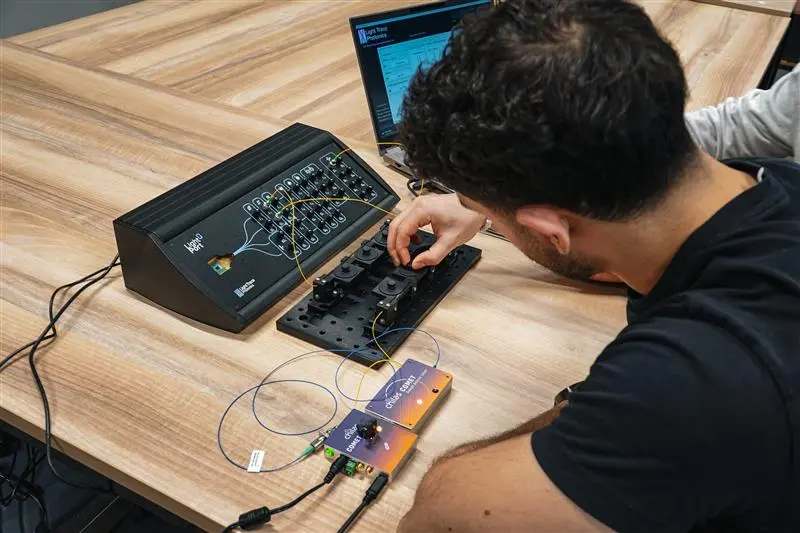
By experimenting with this kit, students learn about the fundamental building blocks of integrated photonics, from waveguides and phase shifters to filters and tunable delay lines. One of the key insights comes when they discover that the COMET 1550 laser used to drive the optical chip – seemingly a simple box connected to their laptop via USB – is itself built on closely related integrated photonic components.
This realization naturally leads to a deeper understanding of how this integrated laser technology enables outstanding performance, such as ultra-narrow linewidths and wide wavelength tunability, opening the door to the genuinely quantum realm: single-photon sources (based on spontaneous four-wave mixing) and photonic operations at the single-photon level.
Applied research: New age of timekeeping
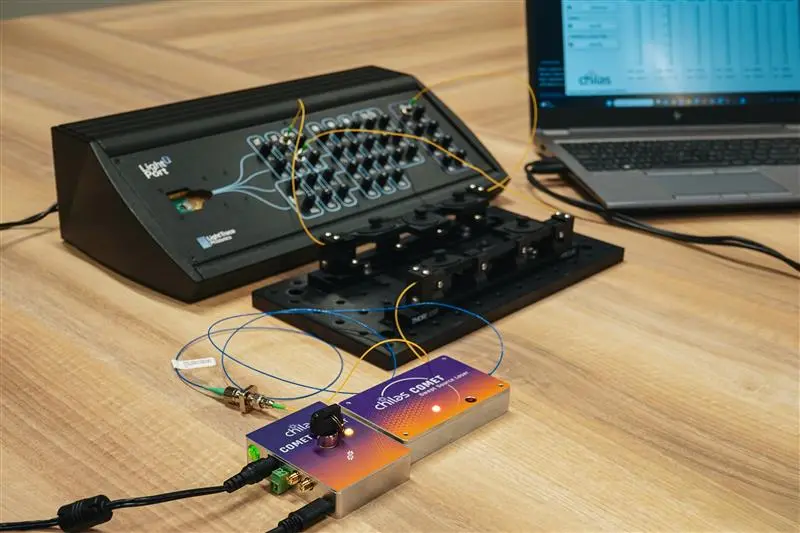
The COMET 1550 laser drives not only PICs but also the ticks of a ground-breaking timekeeping technology – ultra-precise, compact optical clocks. Its narrow linewidth, wavelength tunability, and sufficient output power meet the key requirements for driving atomic vapor cells, the quantum frequency references at the heart of optical clocks.
In ANT’s collaboration with Prof. David Marpaung’s research group at the University of Twente, COMET 1550 has become the natural choice to build a characterization setup at Saxion, which will enable rapid development and testing of compact vapor cells for next-generation miniature optical clocks.
“On top of our wish list was a high-performance, precisely controllable laser that is easy to use, practical, and cost-effective. Chilas’ COMET 1550 was our natural choice.” Gerald Ebberink, lead of the expertise group “Sensing & Interfacing” at ANT
“Having started my professional career at Saxion Hogeschool, I am especially proud to see that the new generation of lasers developed at Chilas are finding their way to future young professionals studying at this applied sciences university, helping drive the development of new application fields.” Dimitri Geskus, CTO at Chilas
About the Applied Nanotechnology research group at Saxion
The Applied Nanotechnology (ANT) research group at Saxion focuses on the development and application of micro- and nanoscale, photonic, and quantum technologies to address practical, real-world challenges. Supported by the national programmes QuantumDeltaNL and PhotonDelta, ANT has established dedicated research lines in applied photonics, building on its expertise in quantum photonic systems, optical sensing, microassembly, and optomechatronics.
Through close collaboration with academic and industrial partners, the group advances the translation of cutting-edge technologies into applied solutions while strengthening regional innovation in quantum and photonic technologies.
In addition to its research mission, the group’s research expertise is directly transferred to teaching and supervision, particularly within the master’s programmes in Applied Nanotechnology and in Applied Quantum Technologies.
Subscribe to Chilas Newsletter!
Stay informed with the Chilas newsletter! Our bi-monthly updates bring you the latest in laser technology, including new product releases, technical insights, customer success stories, and exclusive company news.